

How bejamas/ui ships 5x less JavaScript than shadcn/ui
A three-way benchmark comparing Astro + b/ui, Astro + shadcn/ui, and Next.js + shadcn/ui on the same marketing page.
Published
DraftHow bejamas/ui ships 5x less JavaScript than shadcn/ui
A three-way benchmark comparing Astro + b/ui, Astro + shadcn/ui, and Next.js + shadcn/ui on the same marketing page.



If bejamas/ui looks close to shadcn/ui, the obvious question is: why not just use shadcn/ui with Astro?
That is a fair question. shadcn/ui is a strong model: copy components into your app, style them with Tailwind CSS, and keep ownership of the code. Astro can render React components too, so on paper the path is simple.
The difference is not the component philosophy. It is the runtime.
We built a benchmark to compare the same page in three setups:
- Astro +
bejamas/ui - Astro +
shadcn/ui - Next.js +
shadcn/ui
In this benchmark, shadcn/ui means the standard React and Radix implementation. Astro can render it through React islands, but it does not make those components framework-free.
The short version: moving shadcn/ui into Astro removes much of the Next.js framework cost, but it does not remove the React and Radix runtime cost. For content-first Astro pages, that difference is the reason bejamas/ui exists.
What we measured
The benchmark uses the same marketing one-pager in all three projects. Each version uses Tailwind CSS v4, static output, and the same page structure.
The page includes:
- A header with a navigation menu and two dropdowns
- A hero with a badge and buttons
- Six feature cards, each with a tooltip
- Pricing tabs that switch between two pricing grids
- Long-form text with six inline hover cards
- An FAQ accordion with six items
- A contact form with two selects, three inputs, one checkbox, and labels
- A footer with a separator and link columns
Below is the exact marketing page used for the benchmark. You can also interact with the live demo here: astro-bui.vercel.app
Across the page, the benchmark uses 13 component types: NavigationMenu, Select, HoverCard, Tooltip, Tabs, Accordion, Button, Card, Badge, Input, Label, Checkbox, and Separator.
The Astro + shadcn/ui version is designed to be a fair comparison, not a worst-case scenario. Static components such as buttons and cards are server-rendered where possible, while interactive sections hydrate as separate client:load islands. This way, what you see in the numbers is the cost of React and Radix alone, not Next.js on top of it.
The result
In the tables below, b/ui means Astro + bejamas/ui, Astro shadcn means Astro + shadcn/ui, and Next shadcn means Next.js + shadcn/ui.
| Metric | b/ui | Astro shadcn | Next shadcn |
|---|---|---|---|
| JS bundle, gzipped | 22.80 KB | 119.88 KB | 219.22 KB |
| JS bundle, raw | 60.42 KB | 358.35 KB | 729.83 KB |
| JS files | 7 | 19 | 10 |
| vs b/ui, gzip | 1x | 5.3x more | 9.6x more |
| Zero-JS types | 7 of 13 | 3 of 13 | 0 of 13 |
The difference is easier to understand visually:
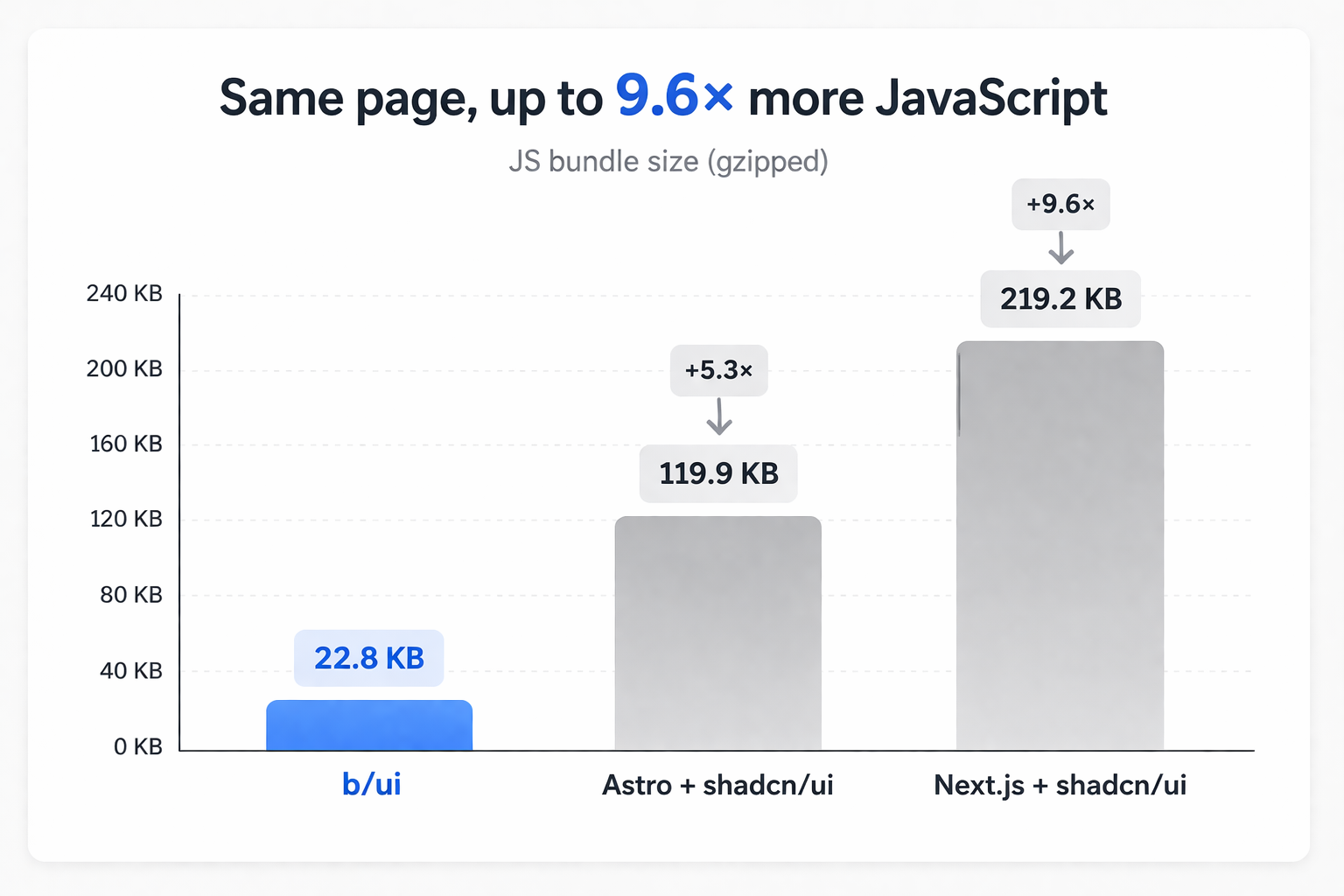
The Next.js number is useful because many teams know shadcn/ui through Next.js. But the more important comparison is the middle column.
Astro + shadcn/ui ships 119.88 KB of gzipped JavaScript for the same page. That is much better than the Next.js version, but still 5.3x more than Astro + bejamas/ui.
That tells us the issue is not only the framework around the app. It is the client runtime needed by React components and Radix primitives.
Why Astro alone does not remove the cost
Astro gives you islands, and islands help. They let you keep static parts of the page as HTML and hydrate only the pieces that need browser behavior.
But a React island still needs React. A shadcn/ui island still uses Radix primitives. When an interactive section hydrates, the browser still has to download, parse, and execute the code needed for that React component tree.
In the benchmark, the Astro + shadcn/ui version includes:
- React and ReactDOM runtime
- Radix shared utilities
- Individual hydrated islands for navigation menu, select, tabs, accordion, tooltip, and hover card behavior
- Astro’s island runtime
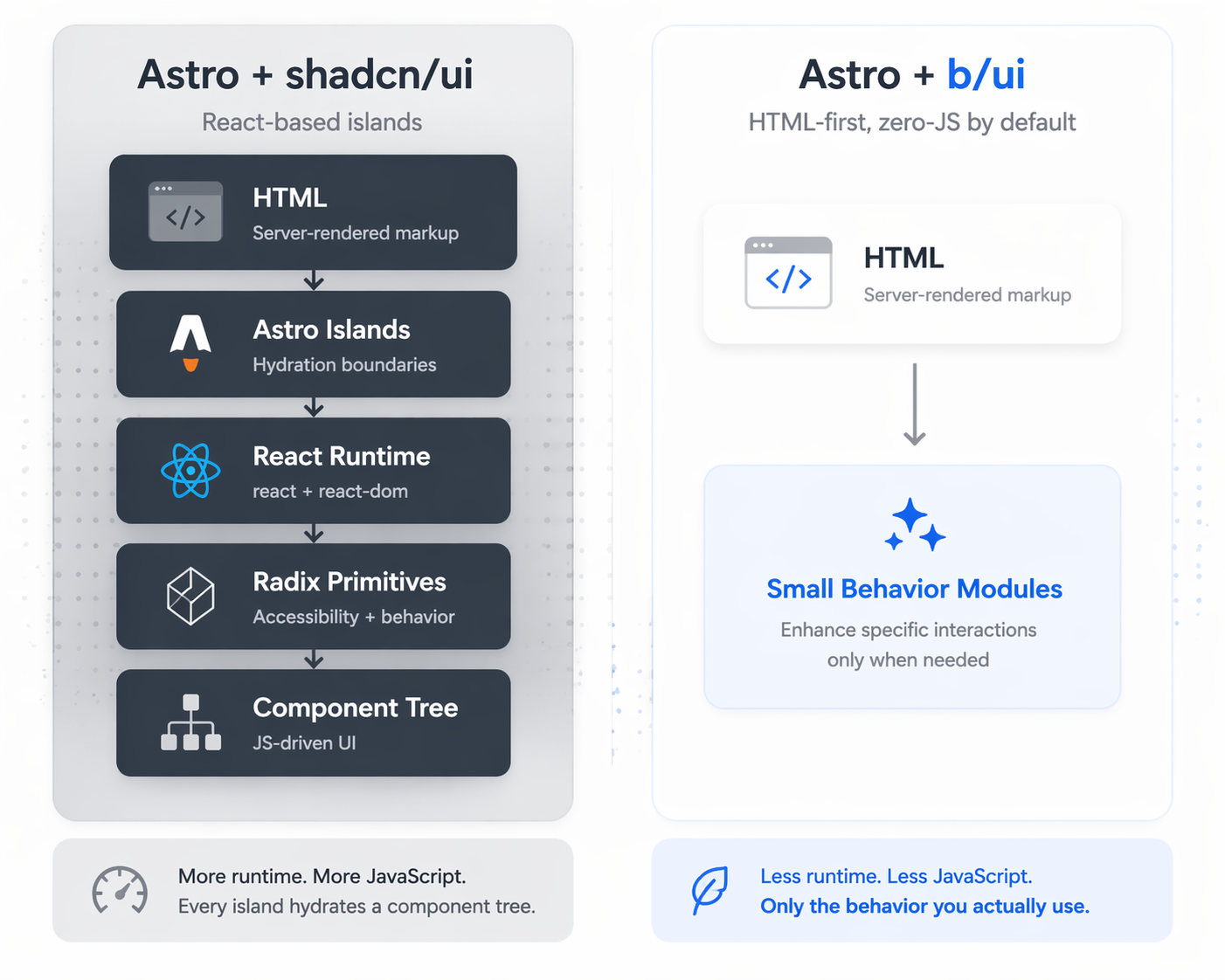
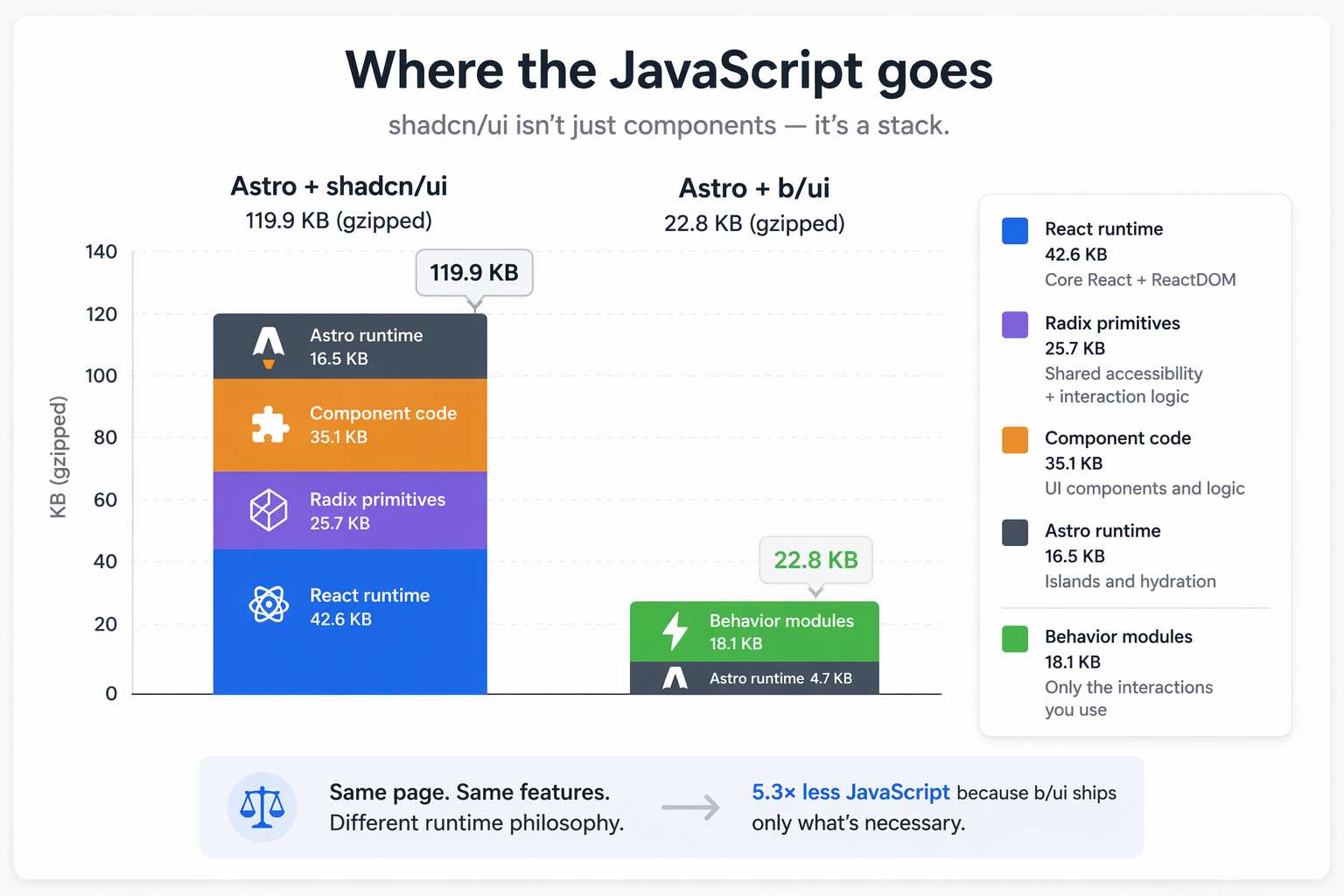
That is why the Astro + shadcn/ui version lands around 120 KB gzip even though the page is statically rendered and the islands are split per section.
The following breakdown shows exactly where that 120 KB comes from:
What b/ui changes
bejamas/ui keeps the same broad authoring model people like in shadcn/ui: own the component code, style with Tailwind, and compose primitives directly in your app.
The implementation model is different. Components are authored as Astro components and render HTML first. Interactive components attach behavior through @data-slot packages instead of hydrating a React tree.
That means static components stay static:
| Component | b/ui | Astro shadcn | Next shadcn |
|---|---|---|---|
| Button | 0 KB | Partial zero-JS | Bundled |
| Card | 0 KB | Partial zero-JS | Bundled |
| Badge | 0 KB | Partial zero-JS | Bundled |
| Input | 0 KB | 0 KB | Bundled |
| Label | 0 KB | Partial zero-JS | Bundled |
| Checkbox | 0 KB | 0 KB | Bundled |
| Separator | 0 KB | 0 KB | Bundled |
In Astro + bejamas/ui, 7 of 13 component types ship no JavaScript. Interactive components still ship JavaScript, but only the small behavior module for that pattern.
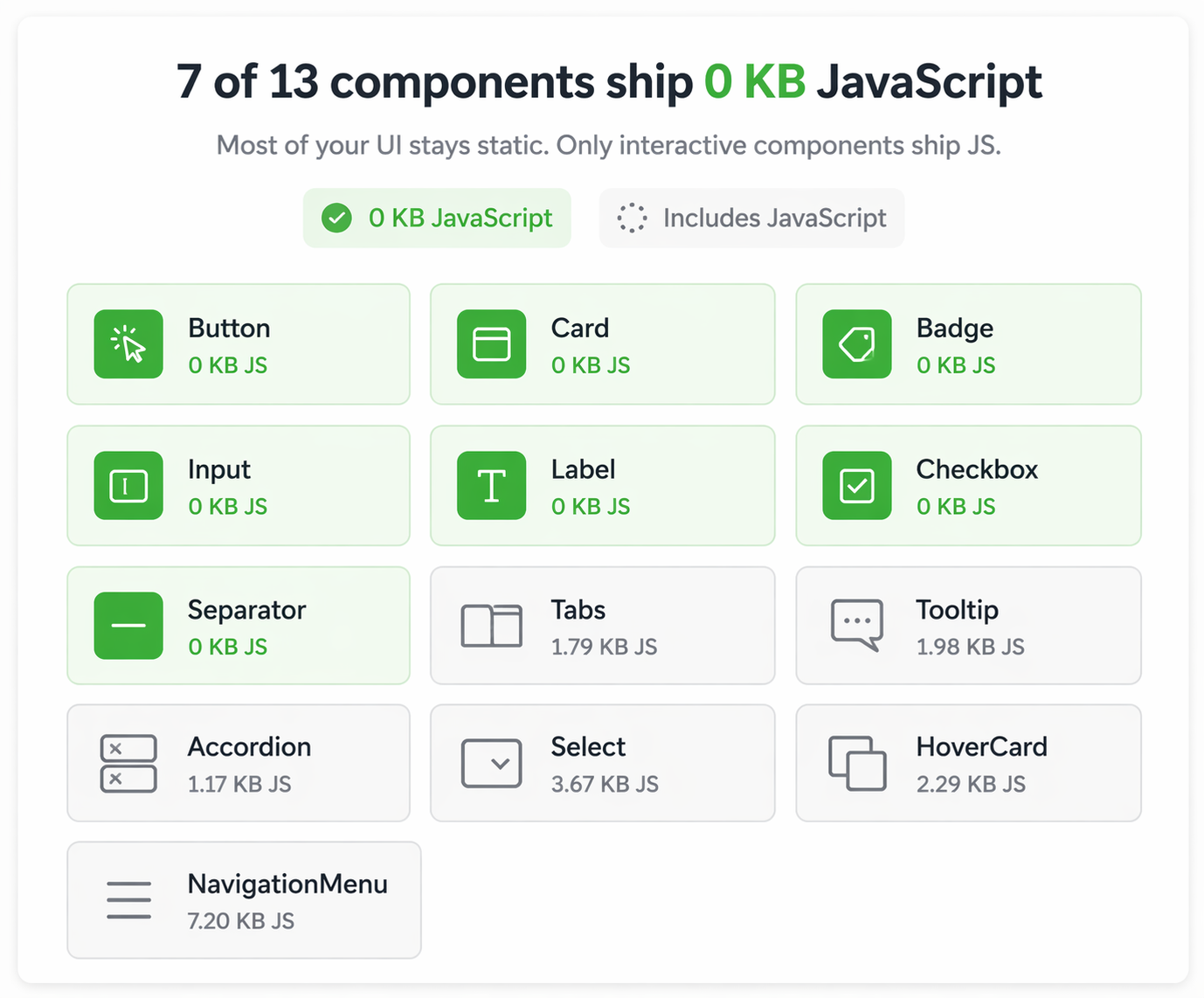
The benchmark breakdown for Astro + bejamas/ui was:
| Interactive module | Gzipped JS |
|---|---|
| NavigationMenu | 7.20 KB |
| Select | 3.67 KB |
| HoverCard | 2.29 KB |
| Tooltip | 1.98 KB |
| Tabs | 1.79 KB |
| Accordion | 1.17 KB |
| Shared Astro runtime | 4.70 KB |
| Total | 22.80 KB |
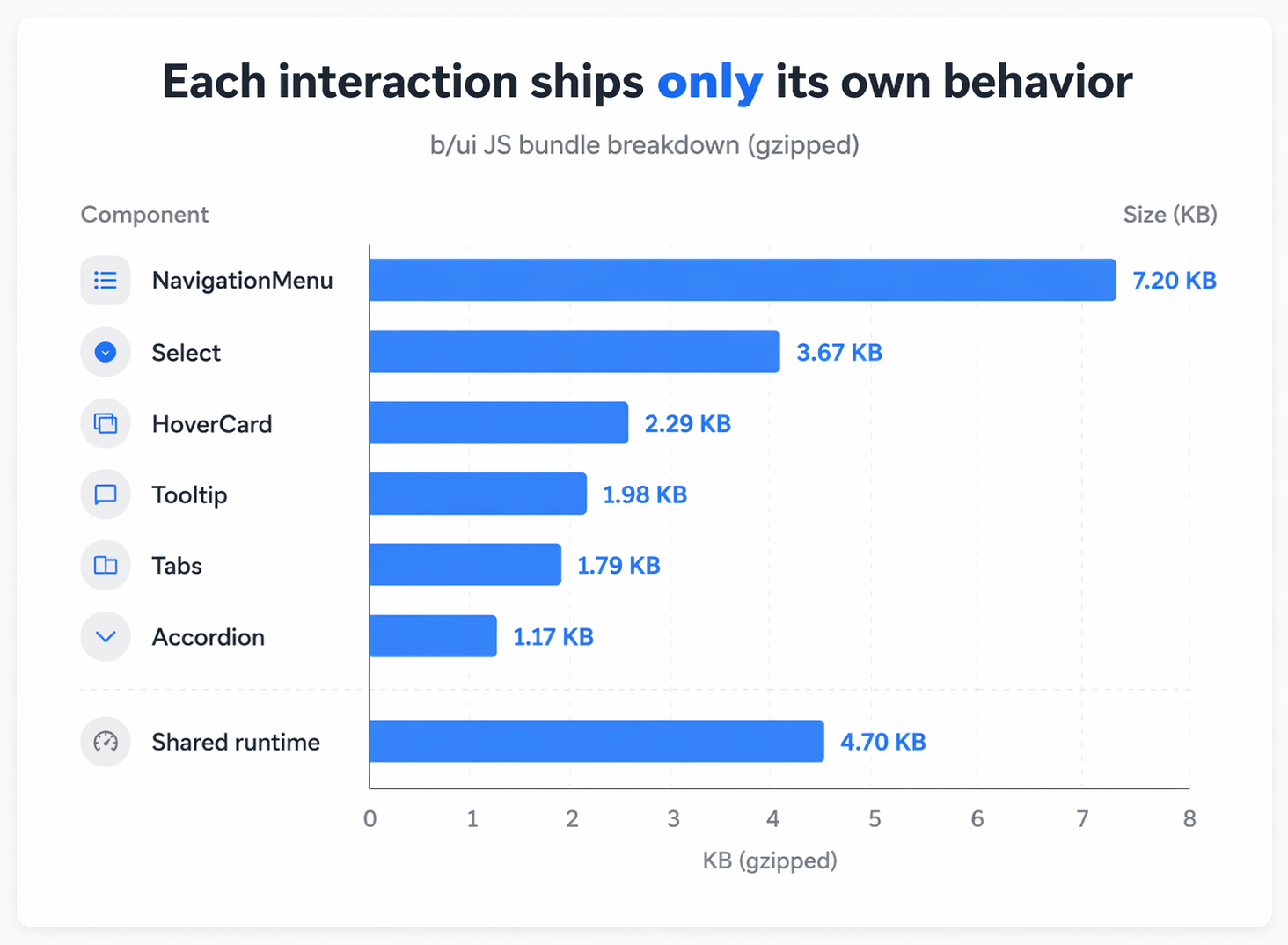
The important detail is not just that the bundle is smaller. It is that the bundle matches the actual behavior on the page.
Tabs need tab behavior. Buttons inside a tab panel do not need to become client-side component functions. In the bejamas/ui version, tabs toggle pre-rendered HTML panels. The button inside the panel is already a DOM node.
In a React tabs island, React still needs the component code for the subtree it renders. That is the difference between enhancing HTML and hydrating a component tree.
When shadcn/ui still makes sense
This benchmark is not an argument that shadcn/ui is wrong. It is an argument about fit.
shadcn/ui still makes sense when:
- Your app is already React-first
- You are building a Next.js app surface where client state and React ecosystem integration matter
- Your team wants Radix primitives specifically
- The page already needs enough React that the incremental component cost is not the main constraint
If that describes the project, using shadcn/ui with Astro or Next.js can be the pragmatic choice.
But if the page is mostly content, marketing sections, documentation, forms, navigation, and a handful of interactive widgets, the runtime cost becomes easier to question. In that case, Astro’s HTML-first model and a React component runtime are pulling in different directions.
The answer
So why use bejamas/ui if shadcn/ui works with Astro?
Because the goal is not just to run shadcn-style components inside Astro. The goal is to keep the Astro-native performance model all the way through the component layer.
bejamas/ui is for teams that want component ownership, Tailwind styling, and familiar composition without carrying a React runtime for content-first Astro pages. The benchmark gives that tradeoff a concrete shape: the same page, the same component categories, and 22.80 KB of gzipped JavaScript instead of 119.88 KB or 219.22 KB.
See the benchmark for yourself
All three implementations, build outputs, measurement scripts, and performance results are available in the benchmark repository.
That includes bundle analysis, Lighthouse scores, code coverage data, and Core Web Vitals measurements so you can inspect the results firsthand.